Artist Activist Amanda D. King Addresses MoCa Cleveland's Cancellation of Exhibition on Police BrutalityIn a time when honest narratives around Black encounters with police are desperately needed, we must strike an ethical balance between artistic expression and the potential harm to others, particularly those most affected, like the victims’ loved ones, or else we run the risk of exploitation and retraumatization. When calling out the atrocities of racial terror, we must practice care, especially for the dead and the mourning.
|
|
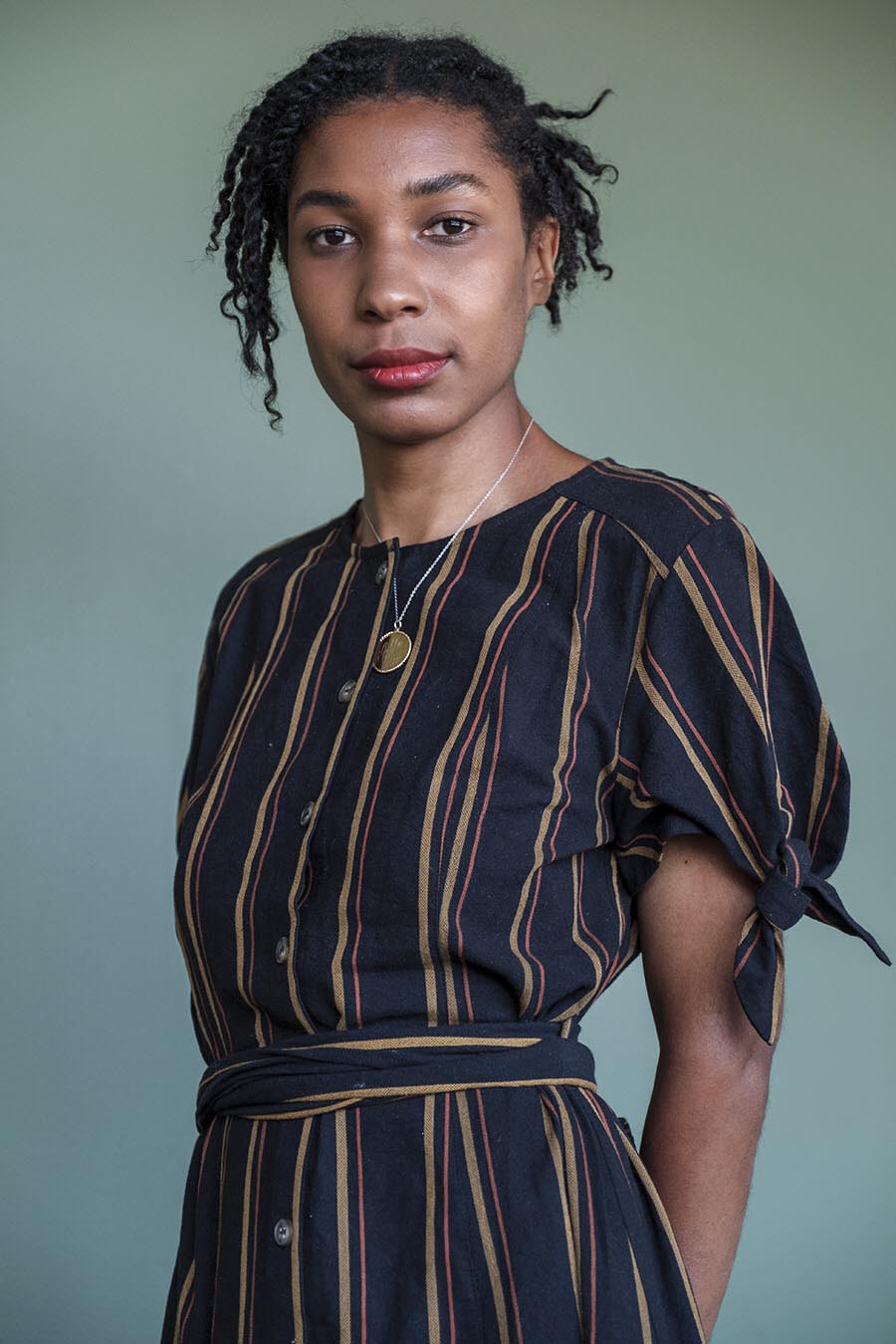
About Amanda D. King
Amanda D. King is a Cleveland-based artist, activist, and educator. Her civically engaged practice utilizes law, art history, and photography to spread progressive ideas and messages of equity through visual language and cultural organizing.
Amanda's work explores Black subjectivity and seeks to awaken society to the enduring struggles and residual strengths of Black people. She is interested in the nexus between the experiences of Black folk and the systemic issues of race, gender, and socioeconomics that affect us all. In a society that weaponizes Blackness to maintain white supremacy--Amanda uses imagery as force to compel racial equity and justice.
Amanda is the Creative Director of Shooting Without Bullets, a for-impact organization using cultural production, artist education and development, activism and advocacy, to model an alternative arts ecosystem that accelerates movement Black and Brown youth and their communities need to thrive.
Amanda holds a Bachelor of Arts in Art History from Bryn Mawr College and a Juris Doctor from Case Western Reserve University where she received the Martin Luther King Jr., Diane Ethics, and Dean’s Community Service Awards.
Amanda's work explores Black subjectivity and seeks to awaken society to the enduring struggles and residual strengths of Black people. She is interested in the nexus between the experiences of Black folk and the systemic issues of race, gender, and socioeconomics that affect us all. In a society that weaponizes Blackness to maintain white supremacy--Amanda uses imagery as force to compel racial equity and justice.
Amanda is the Creative Director of Shooting Without Bullets, a for-impact organization using cultural production, artist education and development, activism and advocacy, to model an alternative arts ecosystem that accelerates movement Black and Brown youth and their communities need to thrive.
Amanda holds a Bachelor of Arts in Art History from Bryn Mawr College and a Juris Doctor from Case Western Reserve University where she received the Martin Luther King Jr., Diane Ethics, and Dean’s Community Service Awards.
Amanda's Statement
What a year it has been. In the midst of the global uprising of the Black Lives Matter movement and the COVID-19 pandemic, I am grateful for every moment that I am able to breathe, love, create and heal. As a Black woman, I’ve long understood that my life could be taken at any moment. I am acutely aware of the daily threats to our humanity resulting from the insidious systems of racism and white supremacy. I have been deeply impacted by the Black death, suffering and traumas I have witnessed and with which I engage regularly in my life, activism, scholarship and artistic practice. During my time in Cleveland, beginning as a student at Case Western Reserve University Law School and throughout my tenure as youth advocate on the Cleveland Community Police Commission, I have worked with the community to increase accountability for crimes against Black citizens, to dismantle oppressive systems and to move our city towards abolition. I am especially committed to activism and advocacy that allows Black and Brown youth to thrive, which is why I founded Shooting Without Bullets -- to directly impact Cleveland teens and young adults.
Since the murder of Tamir Rice, I have worked alongside Ms. Samaria Rice, his mother, helping her to pursue justice for her beloved son, navigate the art world, and address the appropriation and misuse of Tamir’s likeness by artists and cultural institutions. Earlier this year, MoCa Cleveland informed me of plans to present Shaun Leonardo’s exhibition, The Breath of Empty Space, a series of reductive, decontextualized drawings of the police brutality and killings of Black men and boys, including Tamir.
The diptych of Tamir’s murder includes an image of the two officers who shot Tamir with firearms pointed at Tamir, as an obscured Tamir lays on the ground dying behind the patrol car. At first glance, the figures look as if they are in a stand-off with each other, which provokes the viewer to assume that one of the figures is Tamir and the other is the police officer who shot him. Others who viewed the work, including Ms. Rice, made the same assumption. Since 12-year old Tamir is often blamed for his own death because he was playing with a toy gun, I am particularly critical of images that depict Tamir in relation to a firearm. Regardless of the identities of the figures intended by the artist, the work amplifies deeply rooted racist sentiments that the slain were somehow responsible for their own deaths by police.
The exhibition examines violent policing in the US, with officers choking, pointing firearms and neglecting to administer aid to Black victims. The work also erases and reduces parts of these boys and men. The officers are the most prominent figures and the powerless victims are relegated to nothing but empty space. The artist’s objective is to make the viewer confront his/her biases when engaging with these unsettling images. In a time when honest narratives around Black encounters with police are desperately needed, we must strike an ethical balance between artistic expression and the potential harm to others, particularly those most affected, like the victims’ loved ones, or else we run the risk of exploitation and retraumatization. When calling out the atrocities of racial terror, we must practice care, especially for the dead and the mourning.
The artist shares these traumatic and emotionally triggering images to invite viewers to recognize our fears, empathy and ability to transform through discomfort. Yet, without context, this work reinforces racist and patriarchal notions that Black bodies are receptacles made for violence and voyeurism.
As an artist activist, I value artistic freedom and try to incorporate an ethic of care in my own practice. Socially engaged art requires lifelong learning and continuous growth. I am not exempt from this process and recommit daily to learning. I am unwilling to exploit Black pain and unable to stay silent when I see exploitation from other artists and cultural institutions.
I raised these concerns about the exhibition’s promotion of anti-Black racism and the potential harm that could result from the show. I also questioned MoCa’s complicity in commissioning a show about the evils of state-sanctioned violence when it hadn’t addressed its own harmful history of institutionalized racism. With only one Black person on its curatorial team (LaTanya Autry, who raised her own concerns about the exhibition), MoCa has yet to show evidence that the museum values Black intellectual leadership. The museum staff and board seemed unable to discuss in a deeply informed way the issues that would have been raised by hosting this exhibit in our community, including the fact that Cleveland is a majority Black and poor city policed by a majority white militarized police force and that the federal consent decree has resulted in very few structural changes to protect Black citizens from police terror. Case in point, none of MoCa’s leadership was aware that a young, unarmed Black man named Thomas Yatsko was murdered by an off-duty police officer yards away from the museum’s front door in 2018.
In February, after reflection by its staff and board, MoCa decided to cancel the exhibition. After the uprisings in the names of George Floyd, Ahmaud Arbery and Breonna Taylor in late May, the artist and MoCa issued ill-timed, insensitive and misleading statements and apologies. The artist did not respond to the valid criticisms specific to the Cleveland context; the museum blamed a lack of engagement and involvement by the Black community in the decision. This cycle of institutional apathy to Black people followed by a reliance on overworked, underpaid individual Black artists to do damage control and promote community healing is a regular default for Cleveland’s arts ecosystem.
I issue this statement to counteract the false narrative being circulated by the artist and by MoCa Cleveland. I am proud of the efforts I extend every day as an artist activist in the face of opposition and criticism, at the expense of my own peace and protection, and too often without regard for my time, energy and intellectual labor. I uplifted concerns to the museum for the wellbeing of my community and me. I fundamentally believe that arts and culture play a key role in the nuanced and complex fight against racism and it must be fiercely waged in all arenas, including the art world. I remain committed to the fight.
Onward,
Amanda D. King
